Write a Program That Opens Two Text Files and Reads Their Contents Into Two Separate Queue
Yous can bring information from a text file into Access in two ways. If you want a copy of the data that you tin can edit within Admission, import the file into a new or existing table by using the Import Text Sorcerer. If you simply want to view the latest source data within Access for richer querying and reporting, create a link to the text file in your database by using the Link Text Sorcerer.
This article explains how to import and link to a text file by using these wizards.
In this article
-
About text files and supported formats
-
Import information from a text file
-
What else should I know near importing?
-
Troubleshoot missing or wrong values in an imported table
-
Link to a text file
-
Troubleshoot #Num! and incorrect values in a linked table
Almost text files and supported formats
A text file contains unformatted readable characters, such as messages and numbers, and special characters such as tabs, line feeds and carriage returns. Access supports the following file name extensions — .txt, .csv, .asc, and .tab.
To use a text file equally a source file for importing or linking, the contents of the file must exist organized in such a way that the importing and linking wizards can divide the contents into a set of records (rows) and each record into a collection of fields (columns). Text files that are organized properly fall into one of 2 types:
-
Delimited files In a delimited file, each record appears on a dissever line and the fields are separated past a single graphic symbol, chosen the delimiter. The delimiter can be whatsoever character that does not appear in the field values, such as a tab, semicolon, comma, space, and and then on. The following is an case of comma-delimited text.
1,Company A,Anna,Bedecs,Owner 2,Company C,Thomas,Axen,Purchasing Rep 3,Visitor D,Christina,Lee,Purchasing Mgr. 4,Company E,Martin,O'Donnell,Owner v,Company F,Francisco,Pérez-Olaeta,Purchasing Mgr. vi,Visitor G,Ming-Yang,Xie,Owner 7,Company H,Elizabeth,Andersen,Purchasing Rep viii,Company I,Sven,Mortensen,Purchasing Mgr. ix,Visitor J,Roland,Wacker,Purchasing Mgr. ten,Visitor K,Peter,Krschne,Purchasing Mgr. 11,Company L,John,Edwards,Purchasing Mgr. 12,Company M,Andre,Ludo,Purchasing Rep thirteen,Visitor N,Carlos,Grilo,Purchasing Rep
-
Stock-still-width files In a fixed-width file, each record appears on a separate line and the width of each field remains consistent across records. For example, the showtime field of every record is e'er seven characters long, the 2d field of every record is always 12 characters long, and so on. If the actual length of a field'due south value varies from record to record, the values that autumn short of the required width must be padded with trailing space characters. The following is an example of fixed-width text.
1 Company A Anna Bedecs Possessor 2 Company C Thomas Axen Purchasing Rep 3 Company D Christina Lee Purchasing Mgr. 4 Company E Martin O'Donnell Owner 5 Company F Francisco Pérez-Olaeta Purchasing Mgr. 6 Company G Ming-Yang Xie Owner seven Company H Elizabeth Andersen Purchasing Rep 8 Company I Sven Mortensen Purchasing Mgr. 9 Company J Roland Wacker Purchasing Mgr. x Company K Peter Krschne Purchasing Mgr. 11 Company L John Edwards Purchasing Mgr. 12 Company M Andre Ludo Purchasing Rep 13 Company N Carlos Grilo Purchasing Rep
Top of Folio
Import information from a text file
If your goal is to store some or all data that is in a text file in an Admission database, you should import the contents of the file into a new table or append the data to an existing table. You can view and edit the imported data, and the changes you lot make to the data do not affect the source text file.
During the import operation, you tin specify how the source file is organized, and whether you want to create a new tabular array or append the information to an existing tabular array.
At the end of the import operation, you can choose to salve the details of the import operation every bit a specification. An import specification helps you echo the operation at a afterwards time without you having to pace through the Import Text Wizard each time.
Mutual scenarios for importing a text file into Access
Typically, you lot import text data into Access for these reasons:
-
Some of your data is in a format non recognized by Access and you desire to use that data in i of your databases. Yous can offset export the source data as a text file and and so import the contents of the text file into an Admission table.
-
You utilize Access to manage your data, simply y'all regularly receive data in text format from users of a unlike programme. You lot import the data at regular intervals, and you want to streamline the import procedure to relieve fourth dimension and effort.
Note:When yous open a text file in Access (past irresolute the Files of Type list box to All Files in the Open dialog box and and so selecting your text file), Access starts the Link Text Wizard, which allows y'all to create a link to the text file instead of importing its contents. Linking to a file is different from importing its contents. For more information most linking to text files, run into the department Link to a text file, later in this article.
Prepare the source file
-
Open the source text file in a text editor, such equally Notepad.
Note:Yous tin import only one text file during an import performance. To import multiple files, echo the import performance for each file.
-
Review the contents of the source text file and take activity as described in this tabular array.
Element
Description
Delimited or stock-still-width
Make sure the file consistently follows 1 of the formats. If the file is delimited, identify the delimiter. If the file has fixed-width fields, make sure each field is the same width in every record.
Text qualifiers
Some delimited files might contain field values that are enclosed in single or double quotation marks, as shown here:
-
"Pernille Halberg",25,4/5/2017,"New York"
-
"Daniel Brunner",27,2018,"Chicago"
The character that encloses a field value is called a text qualifier. Text qualifiers are not required, but they are essential if either of the following is true:
-
The field delimiter appears equally role of the field values. For example, if comma is used as the field delimiter, and New York, Chicago is a valid field value, you must enclose the value within a pair of qualifiers, similar this: "New York, Chicago"
-
You want Admission to treat non-text values, such as 0452934 and 0034539 every bit text values and store them in a Text field.
During the import functioning, y'all tin can specify whether the file uses a qualifier and, if so, specify the graphic symbol that acts every bit the qualifier.
Brand sure that the aforementioned text qualifier is used throughout the file and that just text values are enclosed inside a pair of qualifiers.
Number of fields
The number of source fields must not exceed 255 — Admission cannot support more than than 255 fields in a table.
Skipping records and values
If you are interested in merely a portion of the text file, edit the source file before yous beginning the import operation. You cannot skip records during the import functioning.
If you lot are calculation the data to a new table, y'all tin can skip sure fields, simply this option is not available if you are appending the contents to an existing tabular array. When you append information to an existing table, the structure of the source information must match the structure of the destination table. In other words, the source information must have the same number of columns as the destination tabular array, and the data types of the source data must match the data types of the destination table.
Bare lines and fields
Delete all unnecessary bare lines in the file. If there are blank fields, try to add the missing data. If you are planning to suspend the records to an existing tabular array, make sure the corresponding field in the tabular array accepts zero values. A field volition accept null values if its Required field holding is set to No and its ValidationRule belongings setting doesn't forbid null values.
Inapplicable characters
Review and remove extra characters, such as tabs, line feed, and carriage returns.
Data types
To avoid errors during importing, make sure each source field contains the same blazon of information in every line. Access scans the outset 25 rows of a file to decide the data type of the fields in the tabular array. We highly recommend that you make certain that the first 25 source rows practise not mix values of unlike data types in any of the fields. Also make sure that non-text values that are to be treated as text values are enclosed in unmarried or double quotation marks.
If the source file contains mixed values in the rows post-obit the 25th row, the import operation might even so skip them or convert them incorrectly. For troubleshooting information, see the section Troubleshoot missing or incorrect values in an imported tabular array, afterwards in this commodity.
Field names
For delimited text files, if the file does not include the names of the fields, it is proficient practice to place them in the first row. During the import operation, you tin specify that Access treat the values in the starting time row as field names. When you import fixed-width text files, Admission does not give you the pick of using the values in the beginning row as the field name.
Annotation:When you append a delimited text file to an existing tabular array, ensure that the name of each column exactly matches the name of the corresponding field. If the name of a column is unlike from the proper name of the corresponding field in the table, the import operation fails. To find the names of the fields, open the destination table in Design view.
-
-
Shut the source file, if it is open. Keeping the source file open up might result in data conversion errors during the import operation.
Start the import process in Access
-
Open up the Admission database in which the imported data will be stored. If you don't desire to store the information in any of your existing databases, create a blank database.
-
Before y'all start the import performance, determine whether you want to store the data in a new or existing table.
-
Create new table If you choose to store the data in a new table, Admission creates a tabular array and adds the imported data to it. If a table with the specified proper noun already exists, Access overwrites the contents of the tabular array with the imported data.
-
Suspend to an existing table If you are adding the data to an existing table, the import process appends the data to the specified table.
Every bit you go on, recall that most suspend operations fail because the source data does not friction match the structure and field settings of the destination table. To avert this, open up the table in Blueprint view, and review the following:
-
First row If the first row of the source text file does not incorporate field names, brand sure the position and data type of each cavalcade matches those of the respective field in the table. For delimited text files, if the first row contains column headings, the order of columns and fields demand not match, simply the proper noun and data type of each column must exactly friction match those of its corresponding field. When yous import stock-still-width text files, Admission does non give you lot the pick of using the values in the start row as the field proper name.
-
Missing or extra fields If one or more than fields are not in the destination table, add together them earlier yous start the import functioning. However, if the destination table contains fields that don't exist in the source file, you need non delete them from the table as long as they accept null values.
Tip:A field volition take nix values if its Required field property is set to No and its ValidationRule property setting doesn't preclude null values.
-
Primary key If the table contains a primary key field, the source file must contain a column that contains values that are compatible with the principal key field. In addition, the imported central values must exist unique. If an imported tape contains a primary fundamental value that already exists in the destination table, the import functioning displays an error bulletin. You must edit the source data then that it contains unique key values so kickoff the import operation again.
-
Indexed fields If the Indexed belongings of a field in the table is ready to Yes (No Duplicates), the corresponding column in the source text file must contain unique values.
-
-
-
The location of the import/link text wizard differs slightly depending upon your version of Access. Cull the steps that match your Access version:
-
If you're using the latest version of the Microsoft 365 subscription version of Access or Access 2019, on the External Data tab, in the Import & Link group, click New Data Source > From File > Text File.
-
If yous're using Admission 2016, Access 2013, or Access 2010, on the External Data tab, in the Import & Link grouping, click Text File.
-
-
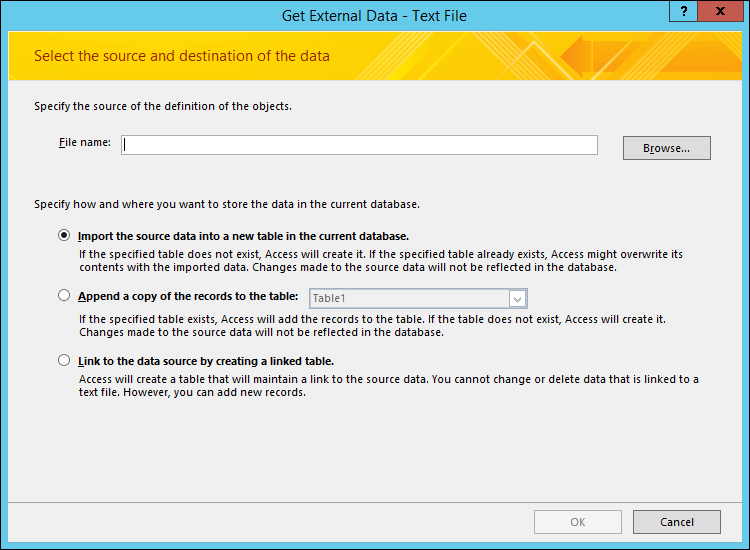
Access opens the Get External Data – Text File dialog box.
-
In the Get External Data - Text File dialog box, in the File proper noun box, blazon the proper noun of the source file.
-
Specify how you want to store the imported data.
-
To store the data in a new table, select Import the source data into a new table in the current database. You volition be prompted to name this table after.
-
To append the information to an existing table, select Append a re-create of the records to the table and then select a tabular array from the drib-down list.
Notation:To link to the data source by creating a linked tabular array, run into the section Link to a text file, later in this article.
-
-
Click OK.
Admission scans the contents of the file and recommends how the file should exist organized. If the file uses a delimiter to split up the fields, ensure that the Delimited option is selected. If the file has fixed-width fields, ensure that the Fixed Width option is selected. If you are unclear near whether your file has fixed-width or delimited fields, run into the previous section, Set the source file.
Note:If the source text file contains tabs or other special characters, these are represented in the Import Text Magician as small boxes betwixt the columns of data.
-
Click Next.
The data that the wizard displays depends on whether you select the Delimited choice or the Fixed-Width option.
Delimited
Select or specify the grapheme that delimits the field values - Tab, Semicolon, Comma, Infinite, or Other. If the file users a text qualifier, in the Text Qualifier box, select either the double quotation mark (") or the single quotation marking ('). If the offset row of the source file contains field names, select the First Row contains Field Names check box. Then, click Next.
Stock-still-width
The wizard displays the contents of the file. If Access detects a columnar structure in the data, information technology places vertical lines in the data to separate the fields. Review the structure suggested past the wizard and, if necessary, follow the instructions on the wizard folio to add, remove, or adjust the lines. So, click Next.
-
If you chose to append the information, skip to step 13. If yous are importing the data to a new tabular array, click Adjacent. At this point, you should review the field backdrop displayed in the wizard.
Note:The magician page on which you can specify information about fields y'all are importing is non displayed if you are appending records to an existing tabular array.
-
Click a column in the lower half of the wizard page to display the corresponding field'southward backdrop. Review and change, if you want, the name and data type of the destination field.
Access reviews the first 25 rows in each column to suggest the default data type for the corresponding field. If there are different types of values, such as text and numeric values, in the get-go 25 rows of a cavalcade, the wizard suggests a information blazon that is uniform with all or most of the values in the column — that is often the Text data type. Although yous tin can choose a unlike data type, remember that values that are not compatible with the data type yous cull are either ignored or converted incorrectly. For more than information most how to correct missing or incorrect values, see the section Troubleshoot missing or wrong values in an imported table, later in this commodity.
-
To create an alphabetize on the field, prepare Indexed to Yes. To altogether skip a source cavalcade, select the Do not import field (Skip) cheque box. So click Next.
-
If the records are being added to a new table, the wizard prompts you lot to specify a primary key for the table. If you select Let Access add together primary key, Access adds an AutoNumber field as the start field in the destination table, and automatically populates it with unique IDs, starting with 1. Click Side by side.
Note:The wizard page on which yous can specify information near fields you are importing is not displayed if you are appending records to an existing table.
-
Access displays the final page of the wizard. If you are importing records into a new tabular array, specify a proper name for the destination table. In the Import to Table box, type a name for the table. If the table already exists, a prompt asks you whether yous desire to overwrite the existing contents of the table. Click Aye to continue or No to specify a different proper name for the destination table.
What is the Avant-garde push button used for?
The Advanced button in the Import Text Sorcerer allows you to create or open an import specification in the format used past earlier versions of Access. Unless you have import specifications from earlier versions of Access (earlier Access 2007), we recommend that y'all practice not utilise the Advanced button. Instead, if you lot want to save the details of this import performance, you can learn more about this procedure in the next department.
-
Click Finish to import the data.
Access attempts to import the data. If any of the data is imported, the magician displays a dialog box that tells y'all the status of the import operation. Conversely, if the operation completely fails, Access displays the error message An fault occurred trying to import file.
-
Open the destination table in Datasheet view. Compare the data in the table with the source file, and brand sure the information appears to be correct.
What else should I know about importing?
-
For data on how to salve the details of your import into a specification that you can reuse afterwards, see the article Save the details of an import or consign operation every bit a specification.
-
For information on how to run saved import specifications, see the article Run a saved import or export operation.
-
For information on how to schedule specifications to run at specific times, see the article Schedule an import or export operation.
-
For information on how to change a specification name, delete specifications, or update the names of source files in specifications, run across the commodity Manage Information Tasks.
Troubleshoot missing or wrong values in an imported table
If y'all come across the bulletin An error occurred trying to import file, the import functioning completely failed. Conversely, if the import performance displays the page that prompts you to salve the details of the operation, the operation managed to import all or some of the data. The status message also mentions the proper name of the fault log table that contains the description of any errors that occurred during the import operation.
Information technology is important to note that fifty-fifty if the status message indicates a successful operation, you should review the contents and structure of the table to ensure that everything looks correct before you start using the table.
Open the destination table in Datasheet view to come across if all the data was successfully added to the table. You should then open up the table in Pattern view to review the data type and other property settings of the fields.
The post-obit tabular array describes the steps you can take to correct missing or incorrect values.
Tip:While troubleshooting, if you find only a few missing values, you can add together them directly to the table in Datasheet view. On the other paw, if you notice entire columns or large number of values either missing or not imported properly, right the trouble in the source file. When yous think you accept corrected all known problems, repeat the import operation.
| Issue | Resolution |
| -1 or 0 values | If the source file includes a field that contains merely Truthful or Faux values or but Yep or No values, and yous selected Yes/No as the data type for the field, y'all will see -1 and 0 in the table. Open the tabular array in Design view, and set up the Format property to either True/Fake or Yeah/No. |
| Multivalued fields | Access does not support importing multiple values in a field. The list of values are treated as a single value and placed in a text field, separated by semicolons. |
| Truncated data | If data appears truncated in a column, attempt increasing the width of the column in Datasheet view. If increasing the width doesn't resolve the issue, the cause might be that the data blazon of a numeric field is set to Long Integer when information technology should have been set up to Double. |
| Data missing in primary key or indexed fields | Records that you are importing contain indistinguishable values that cannot exist stored in the chief key field of the destination table or in a field that has the Indexed belongings set to Yeah (No Duplicates) in an Admission database. Eliminate the duplicate values in the source file and try importing once more. |
| Aught values | When y'all open the table in Datasheet view, you lot might discover that some fields are blank. Do the following to minimize or eliminate whatsoever instances of zero values in the table:
|
In improver, you might desire to review the error log table from the last folio of the magician in Datasheet view. The table has 3 fields — Error, Field, and Row. Each row contains information almost a specific error, and the contents of the Error field should help you troubleshoot the problem.
Complete list of error strings and troubleshooting hints
| Mistake | Clarification |
| Field Truncation | A value in the file is too large for the FieldSize property setting for this field. |
| Type Conversion Failure | A value in the text file or worksheet is the wrong information type for this field. The value might be missing or might appear incorrect in the destination field. See the entries in the preceding table for more data well-nigh how to troubleshoot this event. |
| Central Violation | This record'southward primary cardinal value is a indistinguishable — that is, it already exists in the table. |
| Validation Rule Failure | A value breaks the rule set past using the ValidationRule property for this field or for the table. |
| Zilch in Required Field | A null value isn't allowed in this field because the Required property for the field is set to Yes. |
| Nix value in AutoNumber field | The information that you are importing contains a naught value that you lot attempted to append to an AutoNumber field. |
| Unparsable Record | A text value contains the text delimiter character (usually double quotation marks). Whenever a value contains the delimiter grapheme, the character must be repeated twice in the text file; for instance: 10 - 3 1/2"" disks/box |
Top of Page
Link to a text file
You utilise linking to connect to data in another file without importing it — by doing so, yous can view the latest data in both the original program and in the Access file without creating and maintaining a re-create in Access. If you lot don't desire to re-create the contents of the text file into your Admission database, but however want to run queries and generate reports based on that data, y'all should link to, rather than import, the text file.
When you lot link to a text file, Access creates a new table that is linked to the source file. Whatsoever changes you brand to the source file are reflected in the linked table, however, you lot will non be able to edit the contents of the corresponding table in Access. If you desire to brand changes to the contents or construction of the data, you should open the source file and make the changes in information technology.
Mutual scenarios for linking to a text file from within Access
-
You use a program that outputs data in text format, simply y'all want to use the information for further assay and reporting by using multiple applications, one of them beingness Access.
-
The data yous want to piece of work is maintained by a different section or workgroup. You want to view the latest data, simply don't want to edit or maintain a re-create of your ain.
If this is the starting time time you are linking to a text file
-
When you link to a text file, Access creates a new table, oft referred to as a linked table. The linked tabular array shows the data from the source file, but it doesn't actually store the data in the database.
-
You cannot link a text file to an existing table in the database. In other words, yous cannot suspend data to an existing table past performing a linking performance.
-
A database can incorporate multiple linked tables.
-
Any changes that yous brand to the source file are automatically reflected in the linked table. Even so, the contents and structure of a linked tabular array in Access are read-merely.
-
When you open a text file in Access, Access creates a blank database and automatically starts the Link Text Wizard.
Steps for linking to a text file
-
Locate the text file, and open it in a discussion processing program, such as Give-and-take or Notepad.
Note that you can link to only i text file a time during a link operation. To link to multiple text files, repeat the link operation for each file.
-
Review the contents of the source file, and take action every bit described in the post-obit table:
Element
Description
Delimited or fixed-width
Ensure that the file consistently follows one of the formats. If the file is delimited, identify the delimiting character. If the file has fixed-width fields, ensure that each field is the same width in every record.
Text qualifiers
Some delimited files might contain field values that are enclosed in single or double quotation marks, as shown hither:
"Pernille Halberg",25,4/5/2017,"New York"
"Daniel Brunner",27,2018,"Chicago"
The character that encloses a field value is called a text qualifier. Text qualifiers are not required, but they are essential if:
-
The field delimiter appears as part of the field values. For example, if a comma is used equally the field delimiter, and New York, Chicago is a valid field value, you must enclose the value inside a pair of qualifiers, such as: "New York, Chicago".
-
Yous want Admission to care for non-text values, such every bit 0452934 and 0034539, as text values and store them in a text field.
During the linking operation, you lot can specify whether the file uses a qualifier and, if so, you specify the character that acts as the qualifier.
Ensure that the same text qualifier is used throughout the file and that only text values are enclosed inside a pair of qualifiers.
Number of fields
The number of source fields must not exceed 255 — Access cannot support more than 255 fields in a table.
Skipping records and fields
You tin skip certain fields, but you lot cannot skip records.
Blank lines and fields
Delete all unnecessary blank lines in the file. If in that location are bare fields, effort to add the missing information in the source file.
Extraneous characters
Review and remove actress characters, such as tabs, line feeds, and carriage returns.
Data types
To avoid errors during linking, ensure that each source field contains the same blazon of data in every line. Access scans the start 25 rows of a file to determine the data type of the fields in the table. We highly recommend that you ensure that the showtime 25 source rows do non mix values of dissimilar data types in any of the fields. You should also ensure that whatsoever non-text values that you lot want to be treated every bit text values are enclosed in single or double quotation marks.
If the source file contains mixed values in the rows post-obit the 25th row, the import performance might display error values or convert them incorrectly. For troubleshooting information, see the department Troubleshoot #Num! and wrong values in a linked table, later in this commodity.
Field names
For delimited text files, if the file does non include the names of the fields, it is a good practice to place them in the first row. During the linking operation, you tin specify that Admission treat the values in the first row as field names. However, when y'all import fixed-width text files, at that place is no option for treating the values in the first row as field names.
-
-
Close the source file, if information technology is open up.
-
Open up the database in which you want to create the link. Ensure that the database is not read-simply and that you have the necessary permissions to make changes to the database.
If you don't want to shop the link in whatsoever of your existing databases, create a bare database.
-
The location of the import/link text sorcerer differs slightly depending upon your version of Access. Choose the steps that match your Access version:
-
If you're using the latest version of the Microsoft 365 subscription version of Admission or Access 2019, on the External Data tab, in the Import & Link group, click New Data Source > From File > Text File.
-
If you're using Admission 2016, Access 2013, or Access 2010, on the External Data tab, in the Import & Link grouping, click Text File.
-
-
Access opens the Get External Data – Text File dialog box.
-
In the Get External Data - Text File dialog box, specify the name of the text file that contains the data to which you want to link in the File proper name box.
-
Select Link to the information source by creating a linked table and so click OK.
The Link Text Wizard starts. This wizard guides you lot through the linking process.
-
Access scans the contents of the file and suggests how the file is organized. If the file uses a delimiting graphic symbol to separate the fields, you should ensure that the Delimited option is selected. If the file has fixed-width fields, ensure that the Stock-still Width option is selected.
-
Click Adjacent.
-
The next page of the magician that is displayed depends on whether you selected the delimited pick or the stock-still-width option.
Delimited files Select or specify the grapheme that delimits the field values. If the file users a text qualifier, in the Text Qualifier box, select either " or '. If the first row of the source file contains field names, select the Start Row contains Field Names check box. Then, click Next.
Fixed-width files The wizard shows the contents of the file. If Admission detects a columnar structure in the data, information technology places vertical lines in the data to separate the fields. Review the construction suggested by the wizard and, if necessary, follow the instructions on the magician page to add, remove, or adjust the lines. And so, click Next.
-
On the side by side page of the wizard, Access displays the field properties. Click a cavalcade in the lower half of the wizard page to brandish the respective field'due south properties. Review and modify, if you want, the name and data type of the destination fields.
Access reviews the first 25 rows in each column to suggest the default information type for the respective field. If there are dissimilar types of values, such as text and numeric values, in the first 25 rows of a column, the wizard suggests a data type that is compatible with all or most of the values in the column. In most cases, that is the text information type. Although you lot can choose a unlike information type, retrieve that values that are not compatible with the chosen data blazon will either consequence in error values or get converted incorrectly. For more than information, encounter the next section, Troubleshoot #Num! and incorrect values in a linked table.
What is the Advanced button used for?
The Advanced button in the Import Text Wizard allows you to create or open up a link specification in the format used by earlier versions of Admission. Access does not provide a fashion to save a link specification, different import and export operations, so if you want to save the details of a link specification, click the Advanced push, set the options you want, and and so click Save Equally.
-
Click Side by side.
-
On the final page of the sorcerer, specify a name for the linked tabular array and click Finish. If a table with that name already exists, Access asks if you want to overwrite the existing tabular array. Click Yes if you lot want to overwrite, or No to specify a different table name.
Access attempts to create the linked table. If the tabular array is successfully created, Access displays the bulletin Finished linking table.... Open the linked table and review the fields and information to make sure yous come across the correct data in all the fields.
Elevation of Folio
Troubleshoot #Num! and incorrect values in a linked tabular array
Even if you see the message Finished linking table, you should nonetheless open the tabular array in Datasheet view to verify that all the rows and columns show the correct data.
If you see errors or incorrect data anywhere in the tabular array, accept corrective activity as described in the following tabular array and endeavour linking again. Remember that yous will not be able to add the values directly to the linked tabular array, because the tabular array is read-simply.
| Outcome | Resolution | ||||||||||||
| -1 or 0 values | If the source file includes a field that contains only True or Imitation values or simply Yep or No values, and you selected Aye/No as the information type for the field, you will see -1 or 0 in the table. Open the table in Pattern view and fix the Format holding to True/Simulated or Yes/No. | ||||||||||||
| Multivalued fields | When you lot link information, Admission does not enable support for multiple values in a field. The listing of values is treated every bit a single value and placed in a text field, separated past semicolons. | ||||||||||||
| Truncated data | If data appears truncated in a cavalcade, endeavour increasing the width of the column in Datasheet view. If increasing the width doesn't resolve the issue, the crusade might exist that the data type of a numeric field is set to Long Integer, when it should have been set to Double. | ||||||||||||
| #Num! | When yous open the table in Datasheet view, you might see that some fields incorporate #Num! instead of the actual value. Do the following to minimize or eliminate any instances of null values in the source file:
The following table lists cases where yous will all the same encounter the #Num! error in fields:
|
Elevation of Page
Source: https://support.microsoft.com/en-us/office/import-or-link-to-data-in-a-text-file-d6973101-9547-4315-a8f8-02911b549306
0 Response to "Write a Program That Opens Two Text Files and Reads Their Contents Into Two Separate Queue"
Postar um comentário